
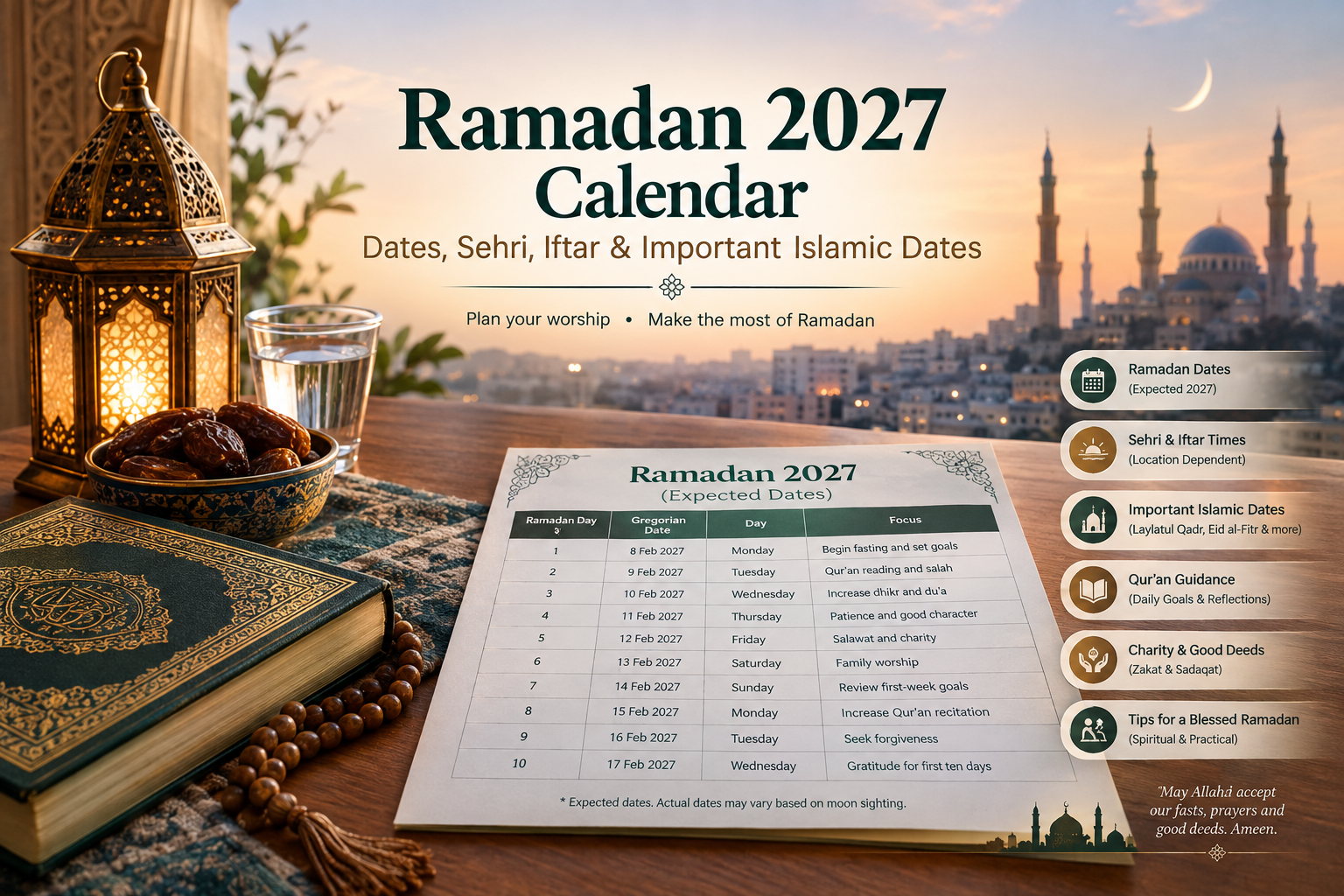

Ramadan is the ninth month of the Islamic lunar calendar and one of the most important months for Muslims around the world. It is a month of fasting, prayer, Qur’an recitation, charity, repentance, and spiritual renewal. Muslims fast from dawn until sunset, increase their worship, and seek the forgiveness and mercy of Allah.
For Muslims planning ahead, the Ramadan 2027 calendar can be a useful way to organize fasting, prayer, Qur’an reading, charity, family activities, and other acts of worship. However, it is important to understand that the exact beginning and ending of Ramadan depend on the Islamic lunar calendar and, according to the Sunnah, the sighting of the new crescent.
When Is Ramadan 2027?
Ramadan 2027 is expected to begin around Monday, 8 February 2027, although the exact date may differ by location and moon-sighting method.
The Islamic calendar is based on the lunar cycle, so Ramadan moves approximately 10–11 days earlier each year in the Gregorian calendar. The beginning of Ramadan is traditionally determined by the sighting of the new crescent moon after the month of Sha’ban.
The Prophet Muhammad ﷺ taught Muslims:
“Fast when you see it and stop fasting when you see it.”
This hadith is recorded in Sahih al-Bukhari and Sahih Muslim and refers to sighting the crescent of Ramadan and Shawwal.
Therefore, any Ramadan 2027 calendar should be treated as a planning guide until the beginning of Ramadan is officially confirmed according to the moon-sighting practice followed by your local Muslim community.
Ramadan 2027: Complete 30-Day Calendar
Note: The dates below are expected dates for planning purposes. The beginning and end of Ramadan depend on the sighting of the crescent moon and may differ by country or local Islamic authority. Ramadan may last 29 or 30 days.
| Ramadan Day | Expected Date | Day | Worship & Planning Focus |
| 1 Ramadan | 8 February 2027 | Monday | Begin fasting and set Ramadan goals |
| 2 Ramadan | 9 February 2027 | Tuesday | Qur’an reading and regular salah |
| 3 Ramadan | 10 February 2027 | Wednesday | Increase dhikr and du’a |
| 4 Ramadan | 11 February 2027 | Thursday | Focus on patience and good character |
| 5 Ramadan | 12 February 2027 | Friday | Increase salawat and charity |
| 6 Ramadan | 13 February 2027 | Saturday | Qur’an reflection and family worship |
| 7 Ramadan | 14 February 2027 | Sunday | Review your first-week goals |
| 8 Ramadan | 15 February 2027 | Monday | Increase Qur’an recitation |
| 9 Ramadan | 16 February 2027 | Tuesday | Make sincere du’a and seek forgiveness |
| 10 Ramadan | 17 February 2027 | Wednesday | Complete the first ten days with gratitude |
| 11 Ramadan | 18 February 2027 | Thursday | Renew your intentions |
| 12 Ramadan | 19 February 2027 | Friday | Give charity and remember the needy |
| 13 Ramadan | 20 February 2027 | Saturday | Study Qur’an meanings and tafsir |
| 14 Ramadan | 21 February 2027 | Sunday | Maintain consistency in worship |
| 15 Ramadan | 22 February 2027 | Monday | Review your fasting and worship routine |
| 16 Ramadan | 23 February 2027 | Tuesday | Increase night prayer |
| 17 Ramadan | 24 February 2027 | Wednesday | Reflect on Allah’s blessings |
| 18 Ramadan | 25 February 2027 | Thursday | Increase istighfar and du’a |
| 19 Ramadan | 26 February 2027 | Friday | Prepare spiritually for the final ten nights |
| 20 Ramadan | 27 February 2027 | Saturday | Prepare for increased worship |
| 21 Ramadan | 28 February 2027 | Sunday | Begin seeking Laylatul Qadr |
| 22 Ramadan | 1 March 2027 | Monday | Increase Tahajjud, Qur’an and du’a |
| 23 Ramadan | 2 March 2027 | Tuesday | Seek Laylatul Qadr and make abundant du’a |
| 24 Ramadan | 3 March 2027 | Wednesday | Continue night worship and charity |
| 25 Ramadan | 4 March 2027 | Thursday | Seek forgiveness and increase good deeds |
| 26 Ramadan | 5 March 2027 | Friday | Increase Qur’an, dhikr and charity |
| 27 Ramadan | 6 March 2027 | Saturday | Seek Laylatul Qadr; avoid assuming it is certainly this night |
| 28 Ramadan | 7 March 2027 | Sunday | Continue worship and prepare for Eid |
| 29 Ramadan | 8 March 2027 | Monday | Seek Laylatul Qadr and watch for Shawwal moon |
| 30 Ramadan | 9 March 2027 | Tuesday | If Ramadan reaches 30 days, complete the fast and prepare for Eid |
Expected dates: Actual Ramadan dates may vary according to local moon sighting and the method followed by your local mosque or Islamic authority. The calendar should therefore be used as a planning guide rather than a definitive timetable.
Important: Sehri (Suhoor) and Iftar times are not included because they vary by location. Muslims should follow the local Fajr and Maghrib times for their city.
Why Do Muslims Fast During Ramadan?
The obligation of fasting Ramadan is clearly established in the Qur’an.
Allah says:
“O you who believe, fasting has been prescribed for you as it was prescribed for those before you, so that you may attain taqwa.”
Qur’an 2:183
The purpose of fasting is therefore much deeper than simply avoiding food and drink. Ramadan teaches Muslims taqwa, meaning consciousness and awareness of Allah.
During the fast, a Muslim leaves things that are normally permissible, such as food and drink, during the prescribed hours. This develops self-control and reminds believers that obedience to Allah takes priority over personal desires.
Allah continues:
“The month of Ramadan is that in which was revealed the Qur’an, a guidance for the people and clear proofs of guidance and criterion.”
Qur’an 2:185
For this reason, Ramadan should be a month of increased connection with the Qur’an.
Sehri and the Sunnah of Suhoor
The pre-dawn meal is commonly called Sehri, Suhoor, or Suhur.
Although a person may fast without eating suhoor, taking suhoor is an important Sunnah.
The Prophet ﷺ said:
“Take suhoor, for there is blessing in it.”
Sahih al-Bukhari and Sahih Muslim
Suhoor should be completed before the beginning of Fajr. Because dawn times differ from one location to another, Muslims should consult a reliable local prayer timetable when determining when to stop eating and drinking.
Suhoor can be simple and nutritious. Dates, water, grains, fruit, eggs, and other suitable foods can be included according to individual needs.
The important point is to begin the fast at the correct time and maintain the intention to fast.
When Does the Ramadan Fast Begin?
The daily fast begins at dawn (Fajr) and continues until sunset (Maghrib).
Allah says:
“Eat and drink until the white thread of dawn becomes distinct to you from the black thread [of night]. Then complete the fast until sunset.”
Qur’an 2:187
This verse establishes the basic daily boundaries of the Ramadan fast.
Because dawn and sunset occur at different times depending on geographical location and the time of year, there is no single worldwide Sehri or Iftar time.
A Ramadan calendar for London, for example, will not have the same fasting times as a calendar for New York, Toronto, Dubai, or Sydney.
Iftar and Breaking the Fast
When the sun sets, Muslims break their fast, an occasion known as Iftar.
The Prophet ﷺ encouraged Muslims to hasten the breaking of the fast when sunset has arrived.
He said:
“The people will continue to prosper as long as they hasten the breaking of the fast.”
Sahih al-Bukhari and Sahih Muslim
The Prophet ﷺ also commonly broke his fast with dates and water.
Iftar is therefore more than a meal. It is an opportunity to thank Allah, make du’a, remember His blessings, and share food with family, neighbors, and those in need.
The Importance of the Qur’an in Ramadan
Ramadan has a unique relationship with the Qur’an.
Allah tells us:
“The month of Ramadan is that in which the Qur’an was revealed…”
Qur’an 2:185
The Prophet ﷺ also reviewed the Qur’an with Jibril عليه السلام during Ramadan. This makes the month an excellent opportunity to establish or strengthen a daily Qur’an routine.
A Muslim could use a Ramadan calendar to set a realistic Qur’an goal, such as:
- Reading a few pages after each obligatory prayer
- Completing one juz’ per day
- Memorizing selected verses
- Reading a Qur’an translation
- Studying tafsir
- Reflecting on the meanings of verses
- Teaching children short surahs and Islamic lessons
The goal should not simply be to finish a certain number of pages. Understanding, reflection, and applying the Qur’an are also important.
Laylatul Qadr in Ramadan 2027
Among the most important nights of Ramadan is Laylatul Qadr, the Night of Decree.
Allah describes this night:
“The Night of Decree is better than a thousand months.”
Qur’an 97:3
The Prophet ﷺ instructed Muslims to seek Laylatul Qadr during the last ten nights of Ramadan, particularly during the odd-numbered nights.
For this reason, Muslims should not limit their worship to one particular night based solely on a calendar prediction.
The last ten nights are an opportunity to increase:
- Salah
- Qur’an recitation
- Dhikr
- Du’a
- Charity
- Repentance
- Night prayer
The Prophet ﷺ would exert himself in worship during the final ten nights more than at other times.
Ramadan and Charity
Ramadan is also a month of generosity.
The Prophet Muhammad ﷺ was described as being especially generous during Ramadan. Muslims can use the month to support relatives, neighbors, or people experiencing hardship.
Charity does not have to be limited to large financial donations. Feeding someone, helping a family, supporting a local mosque, giving useful items, and assisting someone in need can all be forms of good deeds.
Muslims should also prepare for Zakat if it becomes due according to their individual financial circumstances.
Eid al-Fitr After Ramadan
At the completion of Ramadan comes Eid al-Fitr, one of the two major Islamic celebrations.
The exact date of Eid depends on the sighting of the new moon of Shawwal. Therefore, Muslims should not assume that Eid will necessarily fall on a particular Gregorian date simply because an online calendar lists it.
Before the Eid prayer, Muslims give Zakat al-Fitr (Sadaqat al-Fitr) according to the established rulings.
Eid is a time of gratitude to Allah, family gatherings, celebration, and remembrance of Allah.
How to Use a Ramadan 2027 Calendar
A Ramadan calendar can become much more useful when it is used as a worship planner rather than simply a list of dates.
Consider using your calendar to track:
- Fajr and Maghrib times for your local area.
- Daily Qur’an reading.
- Five daily prayers.
- Taraweeh or night prayer.
- Daily charity or acts of kindness.
- Du’a and personal spiritual goals.
- The last ten nights.
- Laylatul Qadr worship.
- Zakat and Zakat al-Fitr preparations.
- Eid al-Fitr preparations.
Families can also create a simple Ramadan planner for children, helping them learn about fasting, salah, Qur’an, good manners, generosity, and gratitude.
Ramadan 2027 Sehri and Iftar Times
The Sehri and Iftar times for Ramadan 2027 will depend on your location. Fajr marks the beginning of the fast, while sunset marks the time to break the fast.
For example, Muslims living in the UK, USA, Canada, Australia, and other countries will have different fasting schedules. Even within the same country, timings can differ between cities.
For this reason, a useful Ramadan 2027 calendar should allow readers to find timings for their specific city rather than presenting one universal schedule.
When checking fasting times, use a reliable local mosque, Islamic organization, or established prayer timetable and follow the method accepted by your local Muslim community.
Final Thoughts
Ramadan 2027 will be an opportunity for Muslims to renew their relationship with Allah and make the Qur’an and Sunnah a greater part of their daily lives.
While a Ramadan 2027 calendar can help with planning, the true purpose of Ramadan goes beyond dates and schedules. Allah describes fasting as a means of developing taqwa, while Ramadan itself is honored as the month in which the Qur’an was revealed.
As the month approaches, Muslims should prepare spiritually as well as practically: learn the rules of fasting, establish a Qur’an routine, plan acts of charity, make sincere du’a, and prepare to take advantage of the blessed final ten nights.
Because Ramadan follows the lunar calendar, the 2027 dates should be regarded as expected dates until confirmed by the relevant moon-sighting authority or local Muslim community. For daily Sehri and Iftar times, always use a reliable timetable specific to your location.
May Allah allow us to reach Ramadan 2027 in good health, accept our fasting and prayers, forgive our shortcomings, and make the Qur’an a source of guidance and light in our lives. Ameen.
Frequently Asked Questions About Ramadan 2027
1. When does Ramadan 2027 start?
Ramadan 2027 is expected to begin around 8 February 2027, subject to local moon sighting.
2. How long will Ramadan 2027 last?
Ramadan may last 29 or 30 days, depending on the sighting of the Shawwal crescent.
3. When will Ramadan 2027 end?
Ramadan is expected to end around 8 or 9 March 2027, depending on whether the month lasts 29 or 30 days.
4. What time does fasting begin in Ramadan 2027?
The fast begins at dawn (Fajr) and continues until sunset (Maghrib). Exact times depend on your location.
5. When is Laylatul Qadr in 2027?
Laylatul Qadr should be sought during the last ten nights of Ramadan, especially the odd-numbered nights.
6. When is Eid al-Fitr 2027?
Eid al-Fitr is expected around 8 or 9 March 2027, depending on the confirmed end of Ramadan.
7. Why is Ramadan important in Islam?
Ramadan is the month in which the Qur’an was revealed, and fasting is prescribed so believers may develop taqwa, as mentioned in Qur’an 2:183–185.
8. Can I rely on an online Ramadan 2027 calendar?
Online calendars are useful for planning, but the final Ramadan and Eid dates should be confirmed by your local mosque or recognized Islamic authority based on its moon-sighting method.

Put correct shortname from your Disqus account in Customizer settings.